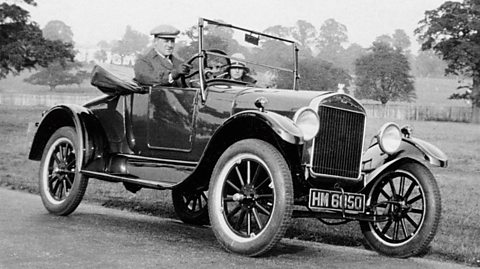
Watch: How has flying changed?
Rian: How does this hot air balloon work, Aunty Maya?
Aunt Maya: Good question, Rian. Above us are our burners, which have a flame that heats the air in the balloon. The hot air inside the balloon is lighter than the cool air outside the balloon, so the balloon is lifted as the hot air rises. Throughout our journey we'll need to be careful to keep the air inside the balloon hot so we can keep flying. Ready for lift-off?
Rian: Yeah!
Aunt Maya: So as our balloon rises we're lifted up in our basket, and we're up, up…
Rian: And away! What an amazing invention!
Aunt Maya: I'll just check the wind is blowing us in the right direction.
Rian: Which way are we going?
Aunt Maya: We are meant to be travelling east across northern Africa. We can check on our navigation system.
Rian: We're going the right way.
Aunt Maya: Great. A hot air balloon was the first flying machine that could carry people. But people from all over the world had used flying for other reasons before. For example, people from China invented kites.
Rian: Like my kite at home.
Aunt Maya: A bit like that, but they weren't just used for fun like your kite. They flew kites high in the sky to send signals to people far away in other towns and villages. And people used trained birds, like pigeons, to carry messages.
Rian: Wow! Birds! I never knew you could train birds.
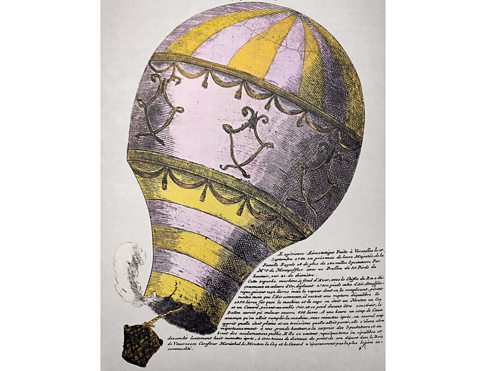
Aunt Maya: But it was the Montgolfier brothers in France who made the first hot air balloon that could carry people. In 1783 in front of the King and Queen of France the brothers launched a huge hot air balloon with a sheep, a cockerel and a duck in the basket underneath.
Rian: Why did they fly animals?
Aunt Maya: They wanted to test if the balloon was safe before sending humans up in it.
Rian: The animals must have been wondering what was happening.
Aunt Maya: Maybe. The balloon was made of a silky cloth and was decorated in blue and gold. It flew for three kilometres, almost 500 metres up in the sky. That's as high as a really tall skyscraper. The balloon landed safely and the animals were unharmed. So later that year, Jacques-Etienne Montgolfier became the first human being to fly up and away from the ground.
Rian: Amazing! Look Auntie Maya! A plane with two sets of wings.
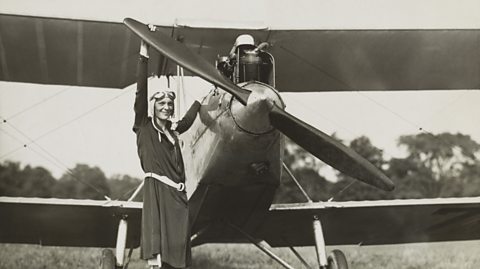
Aunt Maya: That is a biplane. The first motor powered aeroplane was a bit like that and it was flown by the Wright Brothers in America in 1903. It was made from wood and cloth and used a propeller engine. As technology got better, planes were built with single sets of wings using stronger materials such as metal. They could fly much further and faster, even all the way across the oceans. Amelia Earhart was the first woman to fly on her own all the way from America to the UK, across the Atlantic Ocean.
Rian: Pretty impressive! How long did it take her?
Aunt Maya: It took her about 15 hours.
Rian: Do all planes have propellers on the front?
Aunt Maya: Most modern planes use jet engines that make the plane fly much faster. You can now fly across the Atlantic Ocean in about six hours.
Rian: Pretty fast.
Aunt Maya: And that's one of the things that is good about travelling in the air by plane - you can cover much bigger distances in a shorter amount of time. It's faster than any other type of transport.
Rian: Why doesn't everyone just fly everywhere then?
Aunt Maya: Because planes create pollution, which is bad for plants and animals and human beings. They also need a runway to take off and land safely, so they take up a lot of space.
Rian: Ah-ha. And what other flying machines are there?
Aunt Maya: There are helicopters that have long blades on the top that spin and lift it into the air.
Rian: It's a bit like a sideways propeller.
Aunt Maya: It is. And then there are gliders and hang gliders that just float on the wind and air.
Rian: And my favourite - rockets!
Aunt Maya: Yes. They are powered by a super powerful engine that blast them high into the sky.
Rian: All the way to space.
Aunt Maya: The first man and woman to fly in space were from Russia. And people have even used rockets to fly all the way to the moon and back.
Rian: Do you think we can fly to the moon on one of our trips?
Aunt Maya: Maybe. Let's see how we get on in the balloon first.
The Inventors
- People have been trying different ways of flying for hundreds of years.
- The first successful flight was by hot air balloon. In 1783 the Montgolfier brothers launched their balloon, flying five miles before landing safely.
- In 1903 two brothers, Orville and Wilbur Wright, invented and flew the first motor-powered aeroplane. It was called the Wright Flyer.
- The Wright Flyer's first flight was on 17th December 1903 at Kitty Hawk in North Carolina, USA. It lasted just 12 seconds. The aeroplane reached nearly 7 miles per hour (mph). It only flew 120 feet (37 metres) in the air.
The Aviators
- A person who flies an aeroplane is called an aviator.
- In 1927 Charles Lindbergh flew the first non-stop flight across the Atlantic Ocean. His plane was called the Spirit of St. Louis. It took 33 hours to fly from New York City to Paris (3,600 miles).
- In 1930 Amy Johnson became the first woman to fly solo (on her own) from England to Australia.
- In 1932 Amelia Earhart became the first woman to fly solo across the Atlantic Ocean.
Airships
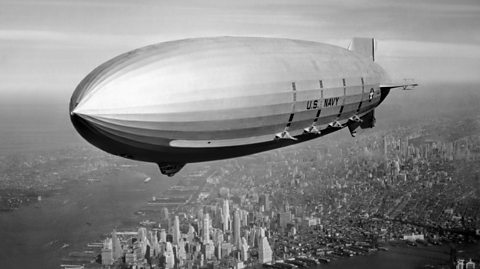
- The early aeroplanes could not carry passengers, but there was another invention which did. In 1900, a German inventor called Ferdinand von Zeppelin designed an airship.
- Airships became more popular in the 1920s and 1930s. They could carry between 24 and 50 passengers. This meant that only rich people could afford to fly.
- An airship stayed in the air by floating.
Passenger aeroplanes
- Flying in an aeroplane became more common in the 1950s and 1960s as more people went on holiday abroad.
- Early jet engines went over 300 mph and could carry up to 60 passengers. They soon became bigger and faster.
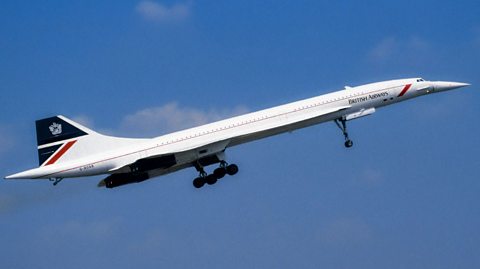
- In 1969 Concorde took its first flight. It was a supersonic plane that could travel 1,354 mph. That's more than twice the speed of sound!
- Larger aeroplanes were known as Jumbo Jets as they could carry more people.
- Many people now can afford to fly. In 2019, over 300 million passengers flew from airports in Britain.
Activities
Activity 1: Put the aircraft in the order they were invented
Activity 2: History of aircraft quiz

More on Changes through time
Find out more by working through a topic
- count1 of 7
- count2 of 7
- count3 of 7
- count4 of 7