The form of An Inspector Calls
The Some poems adopt specific 'forms'. For example, they could be sonnets or narrative poems. Many don’t have an identifiable form. is the type of text and A category or type of something, for example 'fiction' and 'non-fiction' are two examples of different genres of books. Fictional books can be divided into many genres - for example mystery, comedy, fantasy or horror. that the writer chooses to write in.
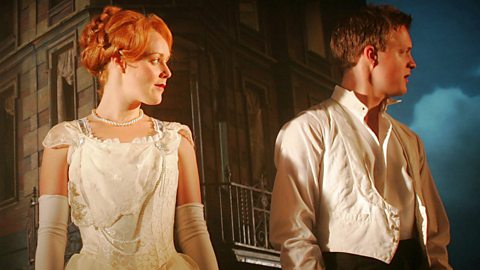
An Inspector Calls is written in the form of a play and so it is meant to be heard and seen in performance. There are stage directions to help guide actors and it is written in lines of dialogue.
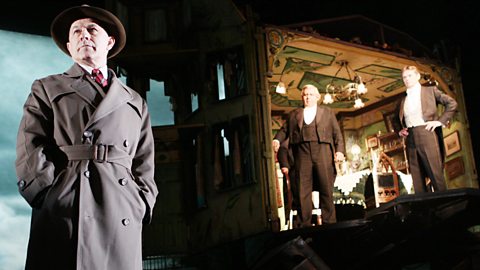
All productions of An Inspector Calls will be different; some might focus on a particular theme or could use staging in different ways which will give the performance a slightly different feel.
An Inspector Calls fits into three possible genres:
- well-made play
- A medieval drama in which characters personify virtues and vices to teach a clear moral lesson to the audience.
- crime thriller
Listen to a podcast about the form, structure and language in JB Priestley's play, An Inspector Calls
Carl: Hello, and welcome to the Bitesize English literature podcast. If you want to hear all the episodes in this podcast, make sure you download the BBC Sounds app.
Jean: In the BBC Sounds app, there's loads of other things you can use to help you with your revision. Full versions of some of the text you might be studying, revision playlists and other Bitesize podcast series to help with different GCSE subjects.
It’s important to let you know that in this podcast, there will be discussions of suicide and sexual abuse.
Carl: In this series, we're going all the way back to 1912 and into a fictional town in the Midlands called Brumley to explore JB Priestley's play An Inspector Calls.
Jean: Jean Menzies, an author and ancient historian.
Carl: I'm Carl Anka, an author and journalist.
Jean: In this episode, we're going to be looking at form, structure and language in An Inspector Calls. Let's start with form. An Inspector Calls is written in the form of a play and it draws on three different genres of play: one - the well-made play, two - the morality play, and three - the crime thriller.
Jean: The well-made play was actually a popular sub-genre of play in the 19th century. In a well-made play, the plot is intricate and complex and the drama of the story builds to a big climax.
Carl: Like in the end of act two.
Extract:
Inspector: (grimly) Don't worry Mrs Birling. I shall do my duty. ( He looks at his watch.)\
Mrs Birling: (triumphantly) I'm glad to hear it.\
Inspector: No hushing up, eh? Make an example of the young man, eh? Public confession of responsibility – um?\
Mrs Birling: Certainly. I consider it your duty. And now no doubt you'd like to say good night.\
Inspector: not yet. I'm waiting.\
Mrs Birling: Waiting for what?\
Inspector: To do my duty.\
Sheila: (distressed) Now, mother – don't you see?\
Mrs Birling: ( understanding now) But surely …. I mean … it's ridiculous . . . (she stops, and exchanges a frightened glance with her husband.)\
Birling: (terrified now) Look Inspector, you're not trying to tell us that – that my boy – is mixed up in this - ?\
Inspector: (sternly) If he is, then we know what to do, don't we? Mrs Birling has just told us.\
Birling: (thunderstruck) my God! But – look here –\
Mrs Birling: (agitated) I don't believe it. I won't believe it . . .\
Sheila: Mother – I begged you and begged you to stop-
Jean: So that's a pretty dramatic climax. A well-made play is a genre of play that started becoming popular around the 1800s. In a well-made play, the action is caused by events that happened before the events of the play, with the story pulling everything back into order at the end.
Priestley moves away from the genre of the well-made play by ending the play with a revelation that actually puts the characters back into jeopardy.
Carl: The audience thinks everything's going to go back to normal when they realise the inspector isn't who he said he was, but then the phone rings and everything goes straight back into chaos. Because when it comes to form, An Inspector Calls is also a morality play.
Morality plays were really popular in the 15th and 16th centuries. In morality plays, characters committed sins and were punished. If they repented, the play showed how the character could redeem themselves. Priestley wanted to remind the audience that they needed not to slip back into old ways after the war had brought about greater quality.
Jean: In An Inspector Calls, Sheila and Eric take responsibility for their actions and say that they're not going to go back to the way things were.
Carl: Whereas Mr and Mrs Birling just want to go back to the way things were before. So Priestley uses the form of a morality play, to invite the audience to judge the characters. Sometimes it feels like inspector’s speeches are being said to the audience.
Jean: Morality plays were also meant to encourage the audience to question their own behaviours. So sometimes when the inspector is talking, he isn't just talking to the characters, he's talking to us, too. It's called breaking the fourth wall, which is when a character acknowledges the fact they're fictional, by addressing the audience directly.
Extract:
Inspector: (dryly) I’ve had that notion myself from time to time. In fact, I've thought that it would do us all a bit of good if sometimes we tried to put ourselves in the place of these young women counting their pennies, in their dingy little back bedrooms.
Carl: The final form that the play An Inspector Calls takes is that of a crime thriller. Now, crime thriller is a genre in which a play tells a gripping tale based around a crime.
Jean: In this case, though, the play revolves around the moral crime of who was responsible for making Eva Smith's life so miserable.
Carl: Exactly. In crime thrillers, the audience receives clues by who's committed the crime. And then they watch the play to try and figure out the twist before the big reveal.
Jean: And in An Inspector Calls the audience spends a whole play slowly learning that everyone in the family was responsible for Eva's death in different ways, which is what makes it such a gripping mystery to watch unfold.
Extract:
Eric: And I say the girl's dead and we all helped to kill her. And that's what matters.
Jean: Okay, let's move on and talk about structure. The play has three acts, and Priestley structured each act to end on a gripping cliff-hanger, which heightens the sense of tension and suspense in the story.
Carl: There's a twist in act three when they realise that maybe Inspector Goole wasn't real. And then another twist at the very end when the phone rings telling them that a woman really did die, and that an inspector is coming over to question them.
Jean: Everything about this play is structured really intentionally. To keep the momentum up, Priestley slowly peels back new parts of the mystery and reveals more about the character and themes of the story. And the play, especially the end, also reflects Priestley's interest in theories about time. Including the idea that people re-enter their lives again after death, and live life all over again.
Extract:
Inspector: And I tell you, that the time will soon come when, if men will not learn that lesson, then they will be taught it in fire and blood, and anguish. Good night.
Carl: Priestley was interested in idea that people could learn how to live better lives and make changes to their past actions to begin a new cycle where they didn't have to repeat the mistakes of their past.
Jean: You can see it in the play, each of these stories the inspector draws out of the characters is kind of like a cycle of its own, which in literature is called a cyclical structure. The play is a cycle of Eva trying to create a better life for herself, being disappointed or punished, then not getting the support she needs, so having to start over again.
Carl: Eva’s life is a cycle of events, she gets knocked down and tries again, over and over and over again until unfortunately, she dies. The play itself also has a cyclical structure. It starts and ends with an investigation into the young woman who has taken her own life. And the older Birlings go right back to avoiding responsibility as they did at the start of the play.
Jean: Sheila and Eric have learned something from their mistakes and act differently to break the cycle.
Extract:
Birling: Now listen, you two. If you're still feeling on edge, then the least you can do is to keep quiet. Leave this to us. I'll admit that fellow's antics rattled us a bit. But we've found him out – and all we have to do is to keep our heads. Now it's our turn.\
Sheila: Our turn to do – what?\
Mrs Birling: (sharply) To behave sensibly, Sheila – which is more than you're doing.\
Eric: (bursting out) What's the use of talking about behaving sensibly. You're beginning to pretend now that nothing's really happened at all. And I can't see it like that. This girl's still dead, isn't she? Nobody's brought her to life, have they?\
Sheila: (eagerly) That's just what I feel, Eric. And it's what they don't seem to understand.\
Eric: whoever that chap was, the fact remains that I did what I did. And mother did what she did. And the rest of you did what you did to her. It's still the same rotten story whether it's been told to a police inspector or to somebody else. According to you, I ought to feel a lot better - (To Gerald.) I stole some money, Gerald, you might as well know - (As Birling tries to interrupt.) I don't care, let him know. The money's not the important thing. It's what happened to the girl and what we all did to her that matters. And I still feel the same about it, and that's why I don't feel like sitting down and having a nice cosy talk.\
Sheila: And Eric's absolutely right. And it's the best thing any one of us has said tonight and it makes me feel a bit less ashamed of us. You're just beginning to pretend all over again.
Carl: The final aspect of this play that we're going to talk about today is language because An Inspector Calls is a play. It's made up of dialogue and stage directions. Priestley wrote the dialogue to be realistic. So there isn't a lot of emphasis on imagery here as you would find in a novel. So instead, there's more of a focus on plain emotive expressions.
Jean: The characters are given lines to perform but then it's them and the director's choice as to how they want to interpret the language and act it out. But Priestley also fills the play with stage directions about how to say things and what needs to be emphasised, to add to the drama of the play.
Carl: There are so many ways to say a line in a play. So Priestley gives some direction. For example, in the first act of the play, Sheila says to Gerald “you be careful” in a response to the idea they will get “too busy for it” when they get married, which can be said in a bunch of different ways. It could be said jokingly or seriously.
Jean: So throughout the play, Priestley specifies how the line should be delivered in the stage directions for that line. Here, he writes that it should be said in a half playful, half serious way.
Carl: Foreshadowing
Jean: Foreshadowing is to suggest what's going to happen in the future. At the start of the play, we don't know that Gerald had an affair, or that Sheila had already suspected it. So the stage directions half playful half serious gives a very early hint to the audience members who are really paying attention that something's not quite right with Sheila and Gerald.
Carl: All the dramatic choices that precede makes it so the form, the structure and the language of An Inspector Calls have a real impact on how the audience experiences the play.
We go deeper into that in the next episode. We're going to talk about dramatisation and all the different ways the play could be performed.
Thanks for listening to this episode of the Bitesize English literature podcast.
Well-made play
A A drama with a carefully structured plot that builds suspense through carefully timed revelations and leads to a satisfying climax and resolution. is a popular dramatic genre from the 19th-century. In a well-made play the plot is intricate and complex and the action builds to a climax. This is often concerned with events that happened before the events of the play. A well-made play usually ends with a return to order but Priestley moves away from this genre with the revelation at the end.
An Inspector Calls has elements of a well-made play because the events are all influenced by what happened to Eva Smith before the play takes place
This structure allows JB Priestley to manipulate the audience. They do not know what happened to Eva Smith and so each revelation about her treatment by the Birlings and Gerald Croft adds to the drama. Each revelation is more shocking than the last and so Priestley cleverly builds to the climax. In An Inspector Calls there is a twist at the end of the plot – the characters are unsure if the Inspector existed at all. This gives the audience time to reflect on the events of the play. When it is revealed that another inspector is on their way and the curtain falls, the audience would be stunned.
Morality play
Morality plays were popular during the 15th and 16th centuries. Historically they sought to teach the audience lessons that focused on the seven deadly sins: lust, gluttony, greed, sloth, wrath, envy and pride. Whilst characters who committed these sins were punished, morality plays showed that if a character repented then they could redeem themselves.
An Inspector Calls has elements of a morality play because all of the Birlings and Gerald Croft commit crimes which are similar to the seven deadly sins. Mr Birling is greedy because he wants more money, Sheila is guilty of wrath and envy when she spitefully complains about Eva Smith and so on. Not all of the characters manage to redeem themselves.
Priestley uses the morality play structure to teach a 20th century audience a series of lessons that relate to his beliefs about social responsibility, age, gender and class. The audience is invited to enjoy judging these characters – they are also forced to question their own behaviour. Priestley would have hoped that people watching the play would have left the theatre as better people.
Crime thriller
A crime thriller is a genre that tells a gripping tale based around a crime. The audience receives clues on who has committed the crime and will enjoy trying to guess what happened before the end of the action.
An Inspector Calls contains many elements of a crime thriller because the action centres around the suicide of Eva Smith. Initially, as this is a suicide and not a murder investigation, it would seem that there is no clear suspect. It soon turns out that all the characters are potential suspects for different reasons.
The crime thriller genre encourages the audience to become involved in the events of the play. In this case they would be considering who is 'more' to blame for the death of Eva Smith. Ultimately, Priestley makes the audience suspects too; their behaviour is questioned and they are left wondering if they had committed any 'crimes' like the Birlings had.
Analysing form
To analyse the form of An Inspector Calls you should:
- remember that An Inspector Calls is a play and so it is meant to be seen in performance
- consider how the events that happened before the action on stage keep the audience guessing
- as it is partly a morality play, think about how the audience judges the characters and themselves
- remember that the audience would be trying to work out if any one person was to blame for Eva Smith's death
The structure of An Inspector Calls
An Inspector Calls is written in a three act structure. Priestley cleverly structures the acts so that they end on gripping cliff-hangers.
There is also a final climax and then a twist at the very end. This use of structure helps to keep the audience gripped and on the edge of their seats.
- As we know, the Inspector is here to investigate the death of Eva Smith. What the audience don't know is what happened in the two years prior to the evening the play takes place. Priestley slowly reveals these events. We never actually meet Eva Smith but we Show understanding of how someone else feels. with her as a character. It is through the Inspector that we get a sense of who she is and what happened to her.
- The closing twist, when it is revealed via phone call that an inspector really is about to call, is a very effective ending. The Birlings and Gerald are stunned, especially Mr and Mrs Birling and Gerald who just a minute ago had been sure they were in the clear. The audience would be shocked and left with lots of unanswered questions.
- The ending also reflects Priestley's interest in theories about time, including the idea that individuals re-enter their lives again after death, living it all over again. They can make changes to their previous actions, beginning a new cycle where they do not repeat the mistakes of their past. We can see this in the A cyclical process is one in which a series of events occurs in a repeating pattern, for example the change of seasons each year. structure of the play as the cycle of events that just took place is about to start all over again, with an investigation into the suicide of a young girl. Sheila and Eric have learned from their mistakes and could escape this cycle, whereas the others have not.
Language and dramatic methods
The language in An Inspector Calls includes The words said by a character in a story or play. and stage directions. Priestley has tried to make the dialogue realistic so there is less emphasis on imagery and more focus on plain, at times emotive, expression.
It is important to consider how the dialogue adds to the drama of the play. The dramatic features of the dialogue include:
- dramatic pauses (make sure you identify the stage directions and/or punctuation marks that indicate a pause!)
- repetition
- gasps and interruptions
- fluency and length
The stage directions also add to the drama of the play. Early in the play, Sheila says to Gerald “so you be careful”. This line could be delivered in a number of ways; each would change its meaning. Priestley specifies that the line is said “half playful, half serious”. This stage direction gives a very early hint to observant audience members that all is not well between Sheila and Gerald. Without it, Priestley's dramatic intentions might be lost.
Priestley also uses dramatic methods such as lighting to affect the atmosphere of the play. The stage directions state that the lighting is “pink and intimate” at the start of the play, creating a warm and cosy effect that mirrors how comfortable the characters are and how ignorant they are of how their actions have affected Eva Smith. When the Inspector arrives, the lighting becomes “brighter and harder”, symbolising how he intends to shine a light on their behaviour and make them see what they’ve done. The light being “harder” suggests a lack of sympathy or mercy on the Inspector’s part; he is determined to confront them with the truth, no matter how uncomfortable it makes them or how it shatters their cosy, self-centred worldview.
When analysing the language Priestley uses, consider:
- What are the ideas Priestley is trying to get across?
- How has he chosen particular words to reflect this?
- What effect does this have on the audience?
Where you can find literary devices (A metaphor is a word or a phrase used for dramatic effect, to describe something as if it were something else. or A quick reference - often to an image, character or place - from a work of literature or music or mythology., for example) try to name these as well as analysing them.
| How | Why | Effect |
|---|---|---|
| Dramatic pauses | ||
| A significant dramatic pause is used at the end of Act One when the Inspector says to Sheila and Gerald “Well?” | Priestley has done this to create a dramatic cliff-hanger at the end of Act One. The placing of the question right before the end of the act stops him – and the audience – from getting an immediate answer. | After the act ended, there would be an intermission. The audience would go into the theatre bar buzzing with questions, desperate for the next act to start. |
| Repetition | ||
| In real life people repeat themselves – Priestley uses this technique to add a sense of realism and character to his dialogue. Eric says “He could. He could have kept her on instead of throwing her out.” | In this instance the repetition shows that Eric is a little uncertain of himself, he hesitates and then repeats himself. | The playwright cannot rely on lengthy descriptions about actions and appearance. This repetition helps get across Eric's character in a subtle way. |
| Gasps and interruptions | ||
| Priestley uses interruptions to add to the drama – for example a panicked Mr Birling quickly interrupts his daughter: “(cutting in) Just a minute, Sheila. Now, Inspector, perhaps you and I had better go and talk this over quietly in a corner.” | This interruption shows that Mr Birling is afraid that his daughter is going to get them into trouble by saying too much. | This makes the audience dislike Mr Birling further. He is shown to be a man who will try to avoid taking responsibility for his actions. |
| Stage directions | ||
| Priestley helps actors with their delivery of lines. Mr Birling loses patience: “(rather impatiently) Yes, yes. Horrid business.” | This ensures that the tone of the scene is kept as Priestley intended. | The effect in this case is to show the arrogance of Mr Birling, he is trying to hurry the Inspector along. Stage directions can be used for a wide range of different purposes. |
| Fluency and length | ||
| Priestley varies the length of the lines the characters deliver, Sheila gives the blunt and snappy line “Because I was in a furious temper” when explaining her behaviour. | The pace of the drama can be controlled by varying the fluency and length of the lines. At first, Mr Birling speaks with enormous fluency, delivering long, self-assured speeches. In contrast, Eric initially delivers lines with pauses and breaks in them. Short, snappy dialogue speeds up the action. Longer speeches can deliver themes and ideas. | Sheila's line shows how ashamed she is of her actions. It also shows her honesty. She doesn't make excuses, she just presents the facts. |
Some other language aspects from within the play might include:
A literary device where an object, person, place, or event represents something beyond its literal meaning. – Eva Smith
Eva Smith is a character but also arguably functions as a symbol within the text, representing all the aspects of humanity who have been disregarded and neglected by society: women, workers, the young, the poor and the “lower class”. Her name supports this: Smith has long been one of the most common surnames in Britain, while ‘Eva’ links her to ‘Eve’, the Biblical mother of humanity and the first symbol of womanhood in Christianity.
Eva is viewed with prejudice and looked down upon by those in power, who use and abuse her for their own ends and resist her attempts to make a better life for herself. She is at once a “real” person who has been wronged by the Birling family and Gerald, and a figurative stand-in representing how Edwardian society has ignored the plight of the less fortunate and taken steps to cut down any who tried to rise up.
The Inspector warns that “There are millions and millions of Eva Smiths and John Smiths still left with us”, showing Eva/Daisy to be a symbolic figure embodying the working class in general, as well as a specific individual who ended her own life.
A simile is a word or phrase used to make a comparison for dramatic effect, using 'like' or 'as'.
There aren’t many examples of imagery used in the dialogue of the play, but it is worth paying attention to any you see. For example, when Mr Birling states “But the way some of these cranks talk and write now, you’d think everybody has to look after everybody else, as if we were all mixed up together like bees in a hive”.
Mr Birling’s simile comparing bees in a hive to people in a society shows his prejudice towards the working class. Bees are famously hardworking, and Mr Birling claims to want hardworking labour, but the fact he doesn’t want to be mixed up in the “hive” where the hard work happens shows that he thinks he is above hard work himself.
The play itself shows how people are indeed “all mixed up together”; Mr Birling’s consistent refusal to acknowledge this proves his ignorance as well as his greed for personal wealth and power.
Informal language
The play creates a sense of realism by having the characters speak in ways that reflect how people would really have spoken. The main characters are all of a higher social class but there is still sometimes use of informal language that is appropriate to them. Sheila is scolded by Mrs Birling for using the slang term “squiffy”, which Mrs Birling considers common and improper. Sheila also uses an A series of words together or phrase that convey a certain meaning that does not reflect the meanings of the words separately. An example is "kicked the bucket". (a commonly understood metaphorical phrase or saying) when she notes: “We’ve no excuse now for putting on airs”.
Mr Birling also uses an idiom when he states “It’s a free country”. When he says this, he is immediately contradicted by Eric, who counters with “It isn’t if you can’t go and work somewhere else” – this undermining of Birling’s supposedly sensible point highlights how common, trite sayings could easily be used to dismiss real social concerns.
The same dynamic is at work when characters like Gerald or Mrs Birling use Polite or neutral words or expressions used to refer to things which people may find upsetting or embarrassing to talk about. to alleviate the awkwardness of speaking plainly in the confrontational way Inspector Goole does. Sexual matters, for example, were not to be bluntly discussed in polite society, so terms like “women of the town” are used for prostitution and Gerald describes his affair with Eva as “relaxation”. Mrs Birling and Gerald use euphemisms the most as they are most aligned with coming from upper class or ‘polite society’ backgrounds.
Allusion
The reference to the Titanic being “unsinkable” is a heavy use of When the audience knows something that the characters don’t. since the audience recognise it as an allusion to one of the greatest tragedies of the 20th century. Likewise, the allusions to “silly little war scares” and other understatements leave the audience in no doubt as to the short-sightedness of Mr Birling, who makes these statements. Mr Birling’s attitude to these things, viewed by an audience aware of the catastrophic war that would happen within two years of his speech, confirm him to be ignorant and out-of-touch, despite his high opinions of himself.
Listen: An Inspector Calls – Dramatisation
Listen to a podcast about the dramatisation of JB Priestley's play, An Inspector Calls
Carl: Hello, and welcome to the Bitesize English literature podcast. If you want to hear all the episodes in this podcast, make sure you download the BBC Sounds app.
Jean: In the BBC Sounds app, there's loads of other things you can use to help you with your revision. Full versions of some of the text you might be studying, revision playlists and other Bitesize podcast series to help with different GCSE subjects.
It’s important to let you know that in this podcast, there will be discussions of suicide and sexual abuse.
Carl: In this series, we're going all the way back to 1912 and into a fictional town in the Midlands called Brumley to explore JB Priestley's play An Inspector Calls.
Jean: I’m Jean Menzies, an author and ancient historian.
Carl: I'm Carl Anka, an author and journalist.
Jean: In this episode, we're going to be looking at dramatisation which is the technical word for how the play would have been performed. It's important to remember that this is a play and plays are written to be performed and watched not necessarily read.
Carl: An Inspector Calls is a play. Priestley wrote it knowing that the directors and actors would develop it further and bring it to life.
Jean: He knew that they would enhance the way the story is told with costumes, lighting, scenery, and a bunch of different technical and artistic choices. Those choices would have a real influence on how the audience would react to the play. So today, we're going to focus on casting, performance and staging and maybe you could think a little bit about how you would like to cast, perform or stage this play.
Carl: In the very first page in the stage directions, Priestley outlines who the characters are, and he's pretty specific about the age, appearance and demeanour.
Jean: He writes that Mr Birling is:
Carl: A heavy looking, rather portentous man in his middle 50s with fairly easy manners, but rather provincial in his speech.
Jean: Portentous is a description of him being a serious man, but the provincial speech shows him as not being sophisticated. Priestley says that Mrs Birling is:
Carl: About 50, a rather cold woman and her husband's social superior.
Jean: But the character that has the most detailed description is the inspector:
Carl: The inspector need not be a big man, but he creates at once an impression of massiveness, solidity, and purposefulness. He's a man in his 50s dressed in a plain dark suit of the period. He speaks carefully, weightily, has a disconcerting habit of looking hard at the person he addresses before actually speaking.
Jean: Because the inspector is one of the most important characters in the play, his casting is particularly important.
Carl: While Priestley gives us a description, casting is often up to interpretation. So in some performances of An Inspector Calls, Inspector Goole can be very confrontational, taking charge and shouting accusations at the Birlings.
Jean: In other interpretations he's softer and more sympathetic. Casting is key. But every director and performance can interpret it differently. So it's worth having a think about some of the different ways that different actors might have interpreted and performed the role of each character. The essentials can be given different shades of meaning through the actors’ choices.
Carl: Okay, that's casting done. Let's move on to the next dramatic choice - staging.
Jean: Like casting, Priestley gives directions for how the performers and directors could stage the play, but it's ultimately up to their interpretation.
Carl: On the first page of the script, Priestley provides pretty clear instructions about how the play should be staged. In some ways, staging is quite simple. The whole story takes place in real time and in one location, which is the Birling dining room.
Extract:
The dining room is of a fairly large suburban house, belonging to a prosperous manufacturer…Edna, the parlourmaid, is just clearing the table, which has no cloth, of the dessert plates and champagne glasses, etc, and then replacing them with decanter of port, cigar box and cigarettes. Port glasses are already on the table… All five are in evening dress of the period, the men in tails and white ties, not dinner-jackets.
Jean: We should say that the presence of cigars and cigarettes is really relevant to this era to paint an accurate picture because this was long before public health messages about smoking. Priestley gives a whole list of props and the stage directions for each act of the play.
Carl: You can have the dining table centred downstairs during act one when it's needed there and then swinging back can reveal the fireplace back for act three. You can show a small table with a telephone.
Jean: And one of the stage directions immediately tells us a lot about the play when Priestley describes the Birling home as heavily comfortable but not cosy and home-like. It's a beautiful house but it's not supposed to feel like a warm and cosy home, which gives the audience their first insight into what the family who lives there is like. Mr And Mrs Birling are very concerned with appearances over pretty much everything else.
Carl: You can use that to describe the whole family as comfortable but not cosy. They are wealthy and from the outside are quite successful. But the reality is they're not a perfect happy family at all.
Jean: No, they are not. And another way the staging reflects the themes that Priestley wanted to explore in his play can be seen in the stage directions. He writes about the lighting of the stage. He says that:
Carl: the lighting should be pink and intimate until the inspector arrives. Then it should be brighter and harder. Because at the start of the play, they're having a private family dinner, which is reflected in the pink intimate light, but then when the inspector comes to interrogate them, and shine a light on who they really are, the lighting becomes brighter and harder.
Jean: Like an interrogation room.
Carl: But like most dramatisation choices, the staging is up to interpretation in Priestley’s stage directions. He acknowledges that the set doesn't have to be realistic.
Jean: Different productions of the play have taken different creative choices with their staging. Some directors have set the play in an industrial area, and another performance set the stage to include an outside area to show Eva Smith acting out her life.
Carl: There's even one performance that built a set of the Birling’s house onto the stage and then had it burst into smoke and flames.
Jean: Finally, performance. Because plays are meant to be performed, not just written.
Before each performance the director and actors make their own choices about how each character, stage direction and idea should be performed. They read the stage directions to see how Priestley originally imagined each scene, but then they put their own spin on it.
Carl: The actors and the director will discuss each character's motivation, which is why a character behaves in the way they do. And they'll use that to inform how they perform each line.
Jean: The director will consider the different themes in the play and might choose to emphasise some and pay less attention to others. For example, if the director was really interested in class, they might make the Birling’s costumes even fancier. Or if they were really focused on gender, they might get the men in the play to speak over the women in the play more.
Carl: Like with all of the dramatisation choices, the performance of the play is all up to each individual director and the actors’ interpretations. So when you're reading the play, be sure to think about all the different ways each line and stage direction could be interpreted.
Jean: Watch any interpretations of a play that are available to you in person or online, because seeing them read the lines out loud and act out each scene will help you to understand the characters and themes that little bit better.
Carl: The next episode of this podcast will be going back in time to 1912 and 1945 to tell you more about the context of An Inspector Calls.
Jean: Thanks for listening to this episode of the Bitesize English literature podcast.
Carl: We’ve still got a lot more to discuss. So have a listen to the other episodes to find out more about Inspector Calls and other books in the English literature podcast series.
You can listen to the whole Bitesize GCSE English Literature podcast series about An Inspector Calls on BBC Sounds.
Test yourself
Further study
Watch: An Inspector Calls (2015) video
The mysterious 'Inspector Goole' interrupts a wealthy family's family party to tell them a young woman died of suicide that night. But what's that got to do with them?

Great Lives: JB Priestly (2011) audio
Comedian Barry Cryer chooses the playwright JB Priestley as someone who inspired him. With Martin Wainwright.

Priestley's Postscripts (2010) audio
Martin Wainwright explores the Second World War broadcasts of the influential playwright JB Priestley.

More on An Inspector Calls
Find out more by working through a topic
- count1 of 5

- count2 of 5

- count3 of 5