Key facts about cells
All living organisms are made up of microscopic cells, which are the basic units of life.
Light microscopes are used to observe cells, with higher magnification providing more detailed views.
Animal and plant cells share structures like a nucleus, cytoplasm and cell membrane, but plant cells also have a cell wall, vacuole and chloroplasts.
Cells can become specialised in multicellular organisms, forming tissues and organs that carry out specific functions.
Cells
Cells are tiny, so we use microscopes to see their details.
A slide is a thin piece of glass used to hold objects which are examined under a microscope.
Chemical stains highlight cell parts making them more obvious and therefore easier to see.
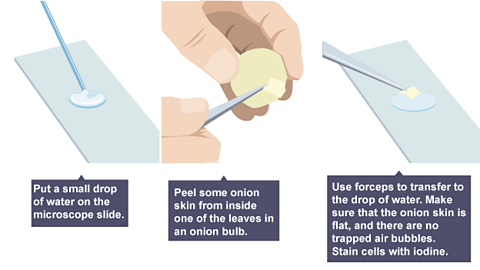
Practical B1: How to make a temporary slide
Plant cells:
Peel a thin layer of cells from an onion.
Place on a slide.
Add a drop of iodine (a chemical stain).
Gently lower a coverslip to avoid air bubbles and prevent drying.
Animal cells:
Collect cheek cells with a cotton bud.
Smear onto a slide.
Add methylene blue (a chemical stain).
Gently lower a coverslip to avoid air bubbles.
Observing and recording
Using a light microscope
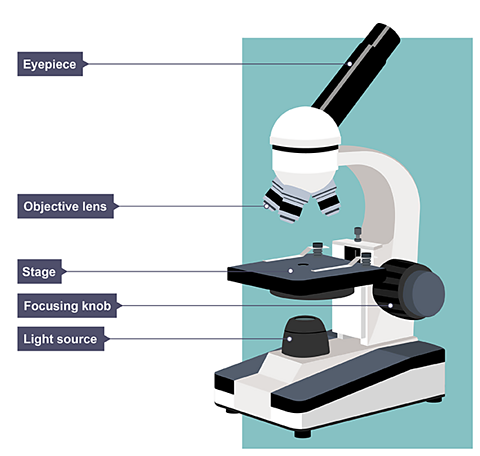
When using a light microscope, start with the low power objective lens, as:
- wider field of view
- easier to find the specimen (what is being viewed)
- less chance of breaking the slide and/or slide
Once centred, switch to a higher power lens for detailed viewing. The lens is very close to the slide so be careful to avoid damaging it.
Total magnification = eyepiece magnification × objective lens magnification.
| Objective lens | Eyepiece magnification | Total magnification | |
|---|---|---|---|
| Low Power | 4X | 10X | 40X |
| Medium Power | 10X | 10X | 100X |
| High Power | 40X | 10X | 400X |
What are cells?
All living things are made up of tiny, microscopic units which we call cells.
What are animal cells made up of?
Animal cells are made up of many different structures:
| Structure | Function |
|---|---|
| Nucleus | Control centre of the cell. It contains the cell’s genetic information arranged in chromosomes. |
| Chromosomes | Threadlike structure found in the nucleus. Made of DNA which contains the genetic information of the cell. |
| Cytoplasm | Chemical reactions take place here. |
| Cell membrane | A selectively permeable boundary surrounding the cell which only allows some substances to enter and leave the cell. |
| Nuclear membrane | Surrounds the nucleus. |
Plant cells
Plant cells contain all of the structures which make up animal cells, but they also include:
| Structure | Function |
|---|---|
| Cellulose cell wall | A rigid structure outside the cell membrane that provides support. |
| Large permanent vacuole | Contains cell sap which provides support. |
| Chloroplasts | Contain chlorophyll, a green pigment that traps light for photosynthesis. |
Stem cells
Stem cells are simple, unspecialised cells found in animals and plants that have the ability to divide to form cells of the same type. They can also into a variety of cells.
Stem cells can be harvested from embryonic umbilical cord or adult bone marrow.
The use of stem cells in medicine has potential benefits including:
- bone marrow transplants in the treatment of leukaemia
The use of stem cells in medicine has risks, with ethical implications, including:
- pre-treatment using radiotherapy or chemotherapy
- transfer of viruses or diseases from other animals
- formation of tumours or development of unwanted cell types
What is specialisation?
Organisms can be:
- single-celled - where all life processes are carried out by one cell
- multi-celled - where cells become specialised to carry out a particular function (eg red blood cells carry oxygen)
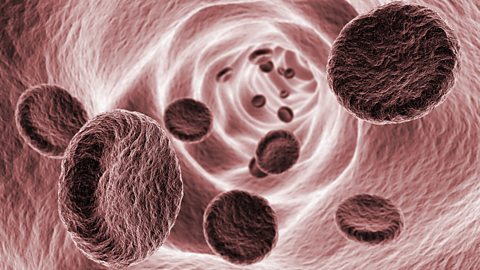
Specialised cells are organised. There are different levels of organisation:
Cell → Tissue → Organ
- Tissue - cells with the same structure and function (eg muscle tissue).
- Organ - several types of tissue that carry out a particular function (eg the heart organ contains muscle and nerve tissue).
- Organ System - organs that work together to carry out a particular function are known as an organ system (eg the ).