Quick version
After World War One ended, economic concerns led many Americans to question immigration polices. It was believed that immigrants had a negative effects on the economy:
- increased competition for jobs
- increased rent prices
- fears that immigrant labour was keeping wages low
- fears that immigrants were being used as workers to break strikes
There were also concerns about the social effects of large-scale immigration on American society:
- immigrants were accused of spreading disease
- rising crime in cities was blamed on immigrants
- alcoholism, gambling and prostitution were blamed on migrants
Events such as the Russian Revolution of 1918 led to fears that European immigrants were introducing radical politics to America, such as communism and anarchism. This period became known as the Red Scare.
Learn in more depth
 Image source, Everett Collection Inc / ALAMY
Before World War One, earlier waves of migration to America came from Northern European countries such as Britain, Germany, and Scandinavian nations. They became commonly referred to as WASPs – White Anglo-Saxons Protestants.
These early migrants shared a common religion and similar cultural traditions with Americans and, as such, had an easier time assimilating into American society.
After the end of World War One, new waves of immigrants came from countries such as Italy, Greece, Russia, Czechoslovakia, Poland, and Romania.
These new arrivals had markedly different religions, languages and cultures to the northern European Protestants who had preceded them. The WASPs felt that their identities were under threat or at risk of being culturally diluted.
Several pieces of legislation were passed which were designed to reduce the number of immigrants that could enter in any given year, effectively closing the door.
Image source, Everett Collection Inc / ALAMYPost-WWI American immigration acts
 Image source, PhotoQuest / Getty
In 1921, the Emergency Quota Act was passed.
The act set a limit of how many immigrants could enter America based on the number of residents from each country who were living in America in 1910. The limit was set at 3% and a cap on the number of A visa a legal document that allows a person to to enter and remain in a country for a period of time. (375,000) which could be issued was also introduced.
In 1924, the Immigration Act further reduced the cap to 2% based on the 1890 census.
In 1929, the quotas were once again readjusted to one-sixth of a percent, based on the 1920 census and the cap on visas was reduced to 150,000.
These acts were designed to provide higher quotas to the countries in northern and western Europe, thus discriminating against those who were not a part of the WASP grouping. The 1924 Act also banned all Asian nationals from migrating to the US.
The widespread hostility shown during America’s involvement in the war had not existed during the isolationist years before the war, suggesting that isolation did not drive this forward after the war ended.
Many Americans wanted to see their status as WASPs protected and believed that through the policies of isolationism and a reduction in immigration, they would be able to preserve the American ideals and values which had emerged as a result of their involvement in WWI.
Image source, PhotoQuest / GettyWhy did America's economy worsen after World War One?
As World War One concluded, America found itself in the grips of A time of temporary economic decline when trade and industrial activity are reduced. as it struggled to return to a peacetime economy.
Many people were quick to blame this on the mass immigration that America was witnessing.
American unemployment after World War One
 Image source, JHU Sheridan Libraries / Getty
During the war, America had employed nine million workers in war-related industries such as munitions and had taken in more men into their armed services.
During the war years (1914 to 1918), US unemployment dropped from around 7.9 percent to 1.4 percent.
Once the war ended, there was no longer a need for these war-related jobs. Many existing workers found themselves unemployed. On top of this, four million returning soldiers struggled to find work
This led to a rapid rise in unemployment – 11.7% in 1921, and was further exacerbated by an increase in the cost of living.
In 1919, the average American family found that their cost of living had increased by 100% compared to before the war began.
Immigrant groups became an easy scapegoat, and in the opinion of many, the only way to return to economic stability was to reduce the numbers of immigrants entering the country.
Image source, JHU Sheridan Libraries / GettyImmigrants as cheap US labour
Throughout 1919, there were over three thousand strikes that broke out across the country as American workers demanded higher pay and better conditions.
In an attempt to continue to make a profit, employers would turn to immigrant workers to break the strikes.
Strike breakers were not always from Europe. Employers were also happy to employ Mexican workers and black Americans to take the place of striking workers.
These immigrants and replacement workers were often willing to work for lower wages. This led to the belief that they were keeping wages low and stealing American jobs.
Why did America fear revolution?
 Image source, Universal History Archive / Getty
After the end of World War One, a series of events led to many Americans fearing the threat of social unrest and even political revolution spreading to the United States.
- 1917 – the Russian Revolution saw the monarchy overthrown and a socialist state created
- 1918 – German Revolution overthrew the German monarchy and introduced a republic
- 1919 – American Communist Party was established
- 1919 – Organised labour strikes across America brought many industries to a standstill
- 1919 – a series of bombings occurred in the US by anarchist groups who wanted to overthrow the state
This fear of revolution and radical unrest became known as the Red Scare.
It made many Americans suspicious of immigrants from countries such as Germany and Russia as it was thought that they could spread revolutionary ideas in America.
Image source, Universal History Archive / GettyThe Palmer Raids, 1919-1920
 Image source, Bettmann / Getty
The Red Scare reached its peak towards the latter months of 1919, with the Palmer Raids.
A. Mitchell Palmer was the US Attorney General. In 1919, Palmer was the target of two bomb attacks. The attackers were identified as immigrant Italian members of an anarchist group.
Palmer used these attacks to gain a platform against communism and organised a series of raids against people and organisations he believed were communists.
As many as 6,000 were arrested and held in a prison without a hearing. Hundreds were deported.
Later, it was generally believed that the Palmer Raids were a response to imaginary threats. Some even claimed that Palmer had used the Red Scare to help advance his political ambitions.
Image source, Bettmann / GettyThe Sacco and Vanzetti prosecution
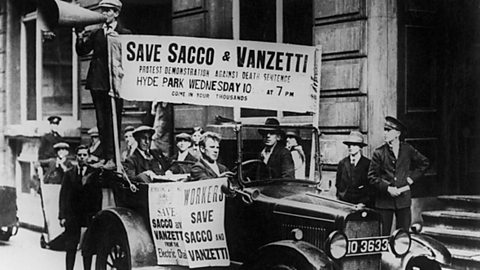
The fear and suspicion of immigrants and radical politics during this period was demonstrated by a controversial court case.
Nicola Sacco and Bartolomeo Vanzetti were Italian immigrants living in America. In 1920, they were both arrested and put on trial for armed robberies that saw two people shot and killed.
Despite weak evidence and numerous witness statements claiming that neither man was involved in the robberies, over two trials for two separate robberies, Sacco and Vanzetti were found guilty and sentenced to death.
The verdicts generated a lot of press attention and there were many who believed that the two Italians were innocent.
Before the trial, it was widely known that both men were anarchists. Their political beliefs and the fact that they were immigrants was believed to have influenced the jury that convicted them.
Both trials had the same judge – Webster Thayer – who was accused of prejudice against immigrants and political radicals. He even stated that while Vanzetti may not have actually committed the crime, he was "nevertheless morally culpable, because he is the enemy of our existing institutions".
The case became well-known internationally, and protests and campaigns for the release of the two men were organised in America.
Despite this, Sacco and Vanzetti were executed in 1927.
Racism and American immigration
 Image source, Bettmann / Getty
The drive for immigration restrictions in the 1920s was also based on pseudo-scientific racism. The eugenics movement played a crucial role in anti-immigrant views transforming into policy.
Eugenics was a belief in improving humans as a species by excluding people with less desirable genes or traits from being able to reproduce. For some in America, the means to improve the nation's bloodline was to stop immigration.
Most influential of all were the widely read articles of Kenneth Roberts in the Saturday Evening Post where he:
- Urged that the immigration laws be revised to admit fewer Polish Jews who were “human parasites”
- Cautioned against Social Democrats since “social democracy gives off a distinctly sour, Bolshevik odour”
- Believed that immigration had to be restricted because it would inevitably produce an undesirable "hybrid race of people"
Nativists believed that the immigrants were a danger to the American way of life. They spoke out against the ‘alien menace’. They believed that immigrants threatened their economic and social position.
The Ku Klux Klan also played a role in the development of anti-immigrant feeling in America.
In order to become a member of the Klan, one had to be an American-born Protestant.
The Klan felt it was their duty to protect their superior WASP culture from what they believed to be inferior peoples and they persecuted Catholics, Jews and other immigrants as well as black Americans.
Image source, Bettmann / GettySocial fears over immigration
 Image source, Everett Collection Historical / ALAMY
The population of American cities was increasing rapidly, accompanied by social problems such as poor housing and rising inner city crime. Immigrants were often blamed for social disorders that burdened American society.
With fewer employment options, immigrants typically found low paid jobs. As such they often lived in cheaper areas that quickly became run down and overcrowded.
The arrival of new waves of immigrants placed strain on urban areas and competition for housing created tension with established residents of these areas.
Crime in cities was often blamed on immigrants, although the real reason for crime was more complex.
Criminal activity such as prostitution, illegal gambling and drinking venues tended to be found in the poorer urban areas where immigrants lived. Wealthier areas tended to be better policed.
Poverty and desperation often fuelled other crimes such as theft.
Organised crime gangs including the Mafia began to grow in power and influence, especially during prohibition. Violent conflict between gangs was covered in newspapers. Gang leaders like Al Capone became notorious and reinforced stereotypes that Italian immigrants were criminals.
Image source, Everett Collection Historical / ALAMYTest your knowledge
Quiz
Recap what you have learned
After World War One ended, varied concerns led many Americans to question immigration polices.
Isolationism
- After America had become involved in World War One, many wanted to end involvement with foreign problems and concentrate on America alone.
- The war had caused divisions in US society, with different immigrant groups sympathising with their country of origin.
- Some citizens were hostile towards the countries they had fought against.
Economic fears
Some saw immigrants as outsiders who threatened their jobs and working conditions:
- Increasing population brought increased competition for jobs.
- More competition for housing led to Increased rent prices.
- Immigrant labour was keeping wages low.
- Immigrants were being used as workers to break strikes.
Social fears
There were also concerns about the social effects of large-scale immigration on American society:
- Immigrants were accused of spreading disease.
- Rising crime in cities was blamed on immigrants.
- Alcoholism, gambling and prostitution were blamed on migrants.
Fear of revolution - the Red Scare
- Events such as the Russian Revolution of 1918 led to fears that European immigrants were introducing radical politics to America.
- Labour strikes across America brought many industries to a standstill and seemed a threat to American business and capitalism.
- Anarchist groups carried out bombings which caused fear and suspicion.
- Media blamed immigrants for stirring up trouble, including labour disputes and bombings.
Prejudice and racism
- Immigrants from Eastern Europe were stereotyped as dangerous radicals.
- The Palmer Raids say hundreds of immigrants arrested and summarily deported without due process.
- Kenneth Roberts' articles in the Saturday Evening Post suggested immigration would produce an undesirable "hybrid race of people".
- The Immigration Act of 1924 gave unfair advantage to immigrants from traditional WASP countries and excluded immigrants from Eastern and Southern Europe, and Asia.
More on USA (1918-1968)
Find out more by working through a topic


