Fire destroys part of rare newts' habitat

 Cambridgeshire Fire & Rescue Service
A charity which runs a fire-hit nature reserve known for its large population of rare great crested newts said the amphibians had "lost an important part of their home".
The fire broke out at privately owned Hampton Nature Reserve, which is run by Froglife, on Tuesday afternoon. At its height nine crews battled the flames.
About 12 acres (4.8 hectares) of the 300-acre site (121 hectares) were affected by the fire, the cause of which is believed to be accidental, said Cambridgeshire Fire and Rescue Service.
"We're concerned that some animals may have been killed in the fire," said Jenny Tse-Leon, Froglife's head of conservation and impact.
"Those that managed to escape have lost the habitat they rely on for shelter, feeding and breeding."
 Froglife
The fire service had only just scaled down a major incident at Holme Fen when crews were called to the blaze at Hampton, another large outdoor fire and about 24 other incidents on Tuesday, a fire service spokesperson said.
The Hampton fire broke out at about 15:40 BST and spread to grass and trees.
The spokesperson said crews "worked hard using jets, hose reels and beaters to extinguish a fire", assisted by a farmer with a water bowser.
They got it under control by about 19:30 and the last firefighters left the scene at about 22:00, returning for inspections.
Tse-Leon praised their work, saying: "We're very grateful for their efforts in bringing these incidents under control and limiting the damage."
 Froglife
The reserve, a former brick pit, has been managed by the charity since 2003.
It is closed to the public because of the presence of protected species. The site is legally protected as a Special Area of Conservation, a Site of Special Scientific Interest and Natura 2000 site.
Visitors are only allowed to visit Hampton as part of Froglife's organised events.
"The recent rainfall is very welcome and has helped reduce the immediate fire risk, but unfortunately the damaged habitat will take time to recover," said Tse-Leon.
"In the meantime, the reptiles that survived have lost an important part of their home and may have very limited suitable habitat to move into."
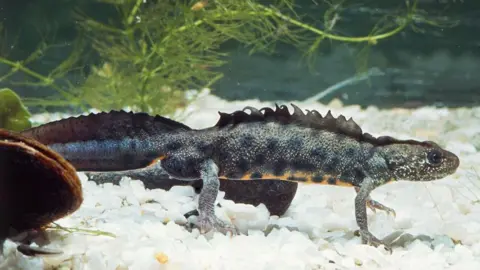
What is a great crested newt?
 Getty Images
- It is the biggest and rarest newt species in the UK
- It has been around for about 40 million years
- Adults have black or dark brown skin and can grow up to 15cm (6in) in length
- Males have a crest along their backs, which is more pronounced during the breeding season
- They are legally protected under UK law, making it an offence to kill, injure, capture, disturb them or their habitat
Source: Froglife
 Froglife
Hampton is also home to slow-worms, grass snakes, dragonflies and butterflies, and attracts many birds.
Tse-Leon urged visitors to nature reserves to be careful to avoid anything that might start a fire, such as safely disposing of cigarettes, not using barbecues and taking glass home.
"A moment's carelessness can have a devastating impact on wildlife and the places they depend on," she added.
Do you have a story suggestion for Peterborough? Contact us below.
Follow Peterborough news on BBC Sounds, Facebook, Instagram and X.