Community group completes 'first' hostile buy-out of eyesore plot in St Andrews

 Poets Neuk
A community group has completed a first-of-its-kind hostile buy-out of a patch of overgrown land in St Andrews.
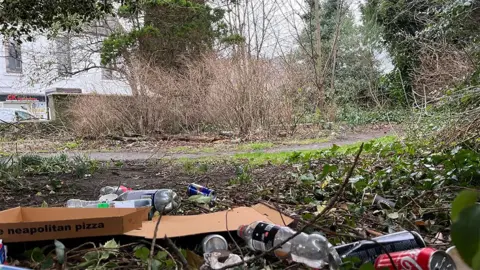
The group, called Poets' Neuk, wants to develop what it describes as "an eyesore plot" in the Fife town into a public poetry garden dedicated to Mary, Queen of Scots.
The landowner, Forthtay Ltd, previously lost an appeal against the decision of Scottish ministers to back a compulsory purchase bid.
Poets' Neuk said it was "delighted and somewhat relieved" that the forced sale had finally gone through.
BBC Scotland News has attempted to contact Forthtay for comment.

The group's secretary, David Middleton, said: "We've tried our best to get on good terms with the landlord, and convince them it was a good idea to pass it on to the community for a reasonable price, and that just failed over time."
He said the plan was now to create a quiet place where the public can "sit and enjoy a rose garden" and read information plaques and poetry about Mary, Queen of Scots' connection to the town.
Poets' Neuk said there were problems with littering and other anti-social behaviour on the area of land.
The group was awarded a grant from the Scottish Land Fund to cover the vast majority of the purchase and raised funds privately for the development as well.
Scottish ministers said they hoped the forced sale would set a precedent that other community groups in Scotland might follow.

Poet's Neuk applied to the Scottish government to buy the former garden under the terms of the Land Reform (Scotland) Act 2016.
That law allows land to be sold to a community group by compulsory purchase if it is likely to further "sustainable development" and is in the "public interest".
Ministers backed the application in 2024 and said the sale could encourage other communities to consider similar opportunities.
Lawyers for Forthtay, an offshore trust based in the Isle of Man, had argued that Scottish ministers acted unlawfully and showed "apparent bias" to the community group when the compulsory purchase decision was made.
After a hearing at Dundee Sheriff Court last year, Sheriff Timothy Niven-Smith ruled that he was satisfied ministers had acted lawfully.
The Scottish government said it welcomed the decision and the completion of the buy-out.
Rural Affairs Secretary Gillian Martin said: "I want to congratulate the Poets' Neuk community for their dedication in persevering through the appeal process and the complex land transactions that were a result of the owner residing outside of Scotland.
"Taking on community assets can be challenging, and we welcome the conclusion of this sale after such a long process."
Land reform campaigners also welcomed the purchase.
Dr Josh Doble from Community Land Scotland said the case demonstrated that "private property rights are not absolute" and were instead "dependent on the public interest."
Malcolm Combe, a reader in law at the University of Strathclyde, acknowledged that some landowners were likely to feel uncomfortable at private property being taken and sold on in this way.
But he said it would not lead to "mass expropriation".
Combe, who also sits on the Scottish Land Fund's committee, said that "very stringent tests" have to be met by any community group who seek to emulate this example.
Why community ownership?
Only one other community group is thought to have successfully applied for a compulsory purchase of this sort.
A community group in Ballindean, in Perth and Kinross, secured backing this year to purchase a small "heritage orchard" with the aim of preserving 150-year-old apple, pear and plum trees.
MSPs are currently looking at how the 2025 Land Reform Act can be implemented and further improved, including adding even stronger community right-to-buy provisions.
Community ownership of assets such as land, buildings and even objects like ferries and pontoons has steadily increased in Scotland over the last 25 years.
Those in favour argue that community ownership and control can encourage economic activity in neglected areas, as well as boosting pride and tackling depopulation.
Most buy-outs are done in negotiation with property owners.
The Scottish government estimates that, as of 2024, there are over 500 community groups owning over 850 assets including 213,803 hectares of combined land.
Individual buildings and small patches of land make up the majority of community-owned assets.
By area, the vast majority of land in community ownership has historically been in the Highlands, Argyll and Western Isles where large estates and entire islands have been brought under community ownership.
Urban communities were given the right to pursue buy-outs in 2016.