Protests as health trusts announce plan for 12% savings

 BBC
BBCNorthern Ireland's health and social care trusts have announced proposals on how they intend to make savings of up to 12% over three years.
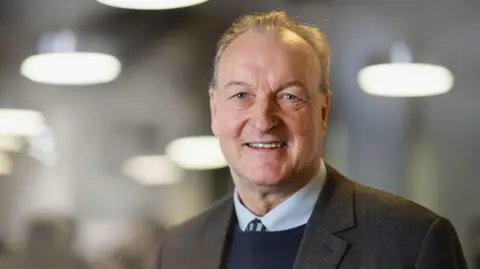
The Permanent Health Secretary, Mike Farrar, said health and social care in Northern Ireland is facing enormous challenges, with a current funding gap of £800m.
Farrar said applying 4% efficiencies to the system each year for three years would initially impact staffing levels.
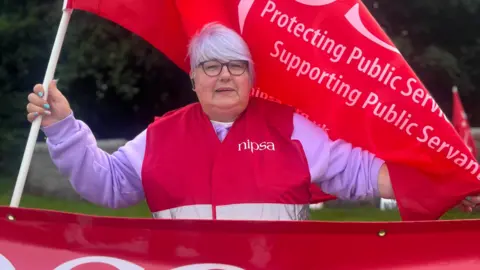
Health unions have told BBC News NI they understand jobs will be affected as the trusts attempt to make the savings. Those posts could include porter and cleaning posts. Unions been holding protests at a number of hospital sites.
 Department of Health
Farrar added that it would be preferable if Northern Ireland had a three-year health budget in place, but even with that the service is overspending about £2m each day.
He said trusts will look first at their use of agency staff and controlling vacancies that emerge.
The Department of Health (DoH) said the Reset and Recovery plan aimed to "restore financial balance, deliver better value for money, and shift investment towards services in the community rather than hospitals, where most funding is currently spent".
"With fundamental elements of the new approach now in place, the HSC has been tasked with delivering 4% cash releasing and efficiency savings this financial year, as part of a three-year recovery plan."
The DoH said at trust level, the plans will include a "a vacancy control process, reducing temporary staffing (including bank, agency and locum staff) and setting the appropriate number of hospital beds as more care is delivered in the community, closer to people's home".
It said trusts will also standardise care pathways, shorten hospital stays and reorganise services to "strengthen and sustain vulnerable services".
There will be a reduction in escalated beds, according to the DoH, which it said will create a "more flexible bed base that can respond to changing demand".
"Trusts will work more closely together on workforce, finance, procurement and partnership decisions through the new Committees in Common structure to ensure every pound is used effectively."
The DoH said that releasing resources in this way will "enable investment in primary care, voluntary sector and better care for older people in their own homes".
 Pacemaker
Speaking to BBC News NI, Ian Boersma from NIPSA said that "when you consider the scale of the cuts everyone will be impacted".
"The first in the firing line, we believe, will be the low paid. It'll be the admin and clerical workers, porters, cleaners," Boersma said.
"The idea that we can do more with less is just nonsense.
"We need the boards to be honest and say what services they are no longer going to provide to the public because that's what we're talking about.
"We're talking about a scaled down NHS and an unsustainable level of cuts."

Stephanie Greenwood, from Unison, said she was "disappointed" and " extremely concerned" by the proposed cuts.
She told BBC Radio Ulster's Evening Extra programme there was "no proper communication with the three unions".
"You cannot make these kind of cuts and provide safe and effective services for patients," she said. "Nor can you bring any more pressure to the workforce."
She said they were "already on their knees".
"To talk about reform is ridiculous with that as a backdrop," she added. "You have to have staff onside."
She said there would be a ballot on industrial action.
 Getty Images
Jane Scott from NIPSA said the cuts will be "detrimental".
"It's a travesty that they are making cuts within our health service. We need to fight for our health service for our users," Scott said.
"The safe staffing that we have saves lives and that needs to be implemented.
Scott said there needs to be a budget that is "based on the needs of the health service, not based on the figures they can pluck out of the air".
"It has to be a needs-based budget to cover what the members out in the public need from their health service."
 Pacemaker
Maeve O'Neill, a physiotherapist in acute medicine at Altnagelvin Hospital in Londonderry, described the proposals as "appalling".
"Right now is the time we need investment in our health and social care services, not cuts.
"We're in a crisis, and at Altnagelvin we're struggling with the number of available beds and trying to meet demand.
"It's absolutely not the time for cuts because cuts don't work. Investment works when it comes to supporting the health of our community," said O'Neill, a former People Before Profit (PBP) councillor.
"It'll have a massive impact because staff are already being squeezed so much.
"I love my job, and I think everybody who works there does, but it's really hard when you're working in a broken system and seeing patients being let down."

John Compton, former chief executive of the Health and Social Care Board, told BBC Radio Ulster's Good Morning Ulster programme that achieving savings of 12% was probably an "undoable ask" in the time available.
He said trusts could rely on "cash control measures", including delaying replacing some staff who leave and controlling spending on community and elective care and deferring buying.
He said the figures were reflective of the failure to "get a proper budget sorted out" and the lack of a three-year budget.
"You need a three-year budget to reform services," he said.
Asked if savings on that scale would affect patients, Compton said: "Ultimately, yes. There's no question about that."
He said the impact could come down to someone asking: "I'm supposed to get 15 community care hours this week. Am I only going to get 10? How am I going to manage."
Analysis: Scale of savings is significant
The scale of the required savings is significant.
To break even the system would have to make about 12% of savings in one year.
A recent health committee heard that the figure wasn't feasible and officials hoped that could be spread over several years.
The Department of Health (DoH) and the health trusts are expected to officially respond to how efficiencies could be tackled.
While the official line in the current climate is that efficiencies have to be made, unions describe the move more like cuts.
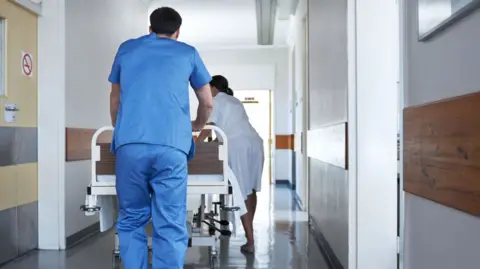
There are concerns that if there are fewer porters then other staff would be expected to pick up their work, such as bringing patients for X-rays and delivering food.
The £800m includes £300m to fund pay awards and the Real Living Wage for 2026-2027.
It means there is very little to fund service growth to cope with an ageing population and new drugs.
During a Stormont health committee meeting the DoH said it could not fund 12% efficiencies in a single year.
Plans on how it and the health trusts will make savings will be spelt out later.
The main concern is whether the cuts will impact patients.