Working in green and yellow office difficult, says ITFC sponsor

 Qays Najm/BBC
A technology boss said he has had to make peace with the fact his firm's new headquarters is coated in the colours of his beloved Ipswich Town's arch rivals.
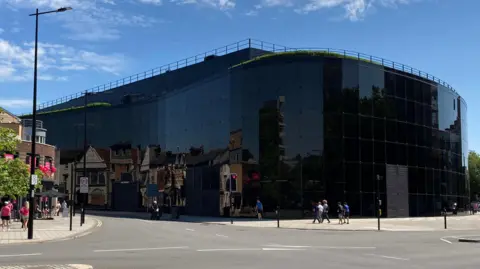
Paul Hamilton is the founder of Halo, which has just moved into the town's iconic Willis Building - a Grade I listed glass office space designed by Lord Foster.
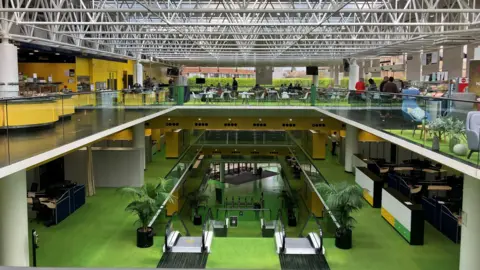
The interior office spaces are yellow and green – the club colours of Norwich City – which Hamilton, a "massive" fan of the Blues/Tractor Boys, has quickly had to get used to.
"When I first saw it I was like 'there's no way we can make this work', and it was difficult at first, but we are not going to change it," he said.
 Andrew Woodger/BBC
The building, opened on 2 June 1975 with a roof-top garden and an indoor swimming pool, was one of the first buildings designed by Foster.
Considered one of Britain's foremost architects, his other buildings include London's Gherkin and the main terminal building at Stansted Airport in Essex.
The colour scheme was designed to evoke a sense of sunshine, grass and the natural world, and Foster said he "had no idea" about Town's rivalry with the Canaries.
Since then, however, Halo has become Town's shirt sponsor in what the club said was the biggest sponsorship deal in its history.
"Norman Foster knows what he's doing, and so it's green and yellow for a reason," added Hamilton.
"When I walked into the building there was a feeling no other buildings have given me – it is just so bright and creates this energy, and it's part of the building.
"It makes it very special, [but] there's already some Ipswich shirts going up here and there, so we're just going to have to have Ipswich colours all over the place."
Halo is keeping one of its two offices in Stowmarket, where it started. The rest of the Willis Building is occupied by the insurance firm, now known as WTW.
 Matt Marvel/BBC
Aside from a slight bit of redecorating, Hamilton has grand plans for the extent to which the revolutionary office building will act as a launch pad for his company.
Worth an estimated £1bn, the global software firm builds information technology service management and workflow platforms, used by major organisations such as Microsoft and Red Bull.
Over the next decade, Hamilton believes "more and more" organisations will want to relocate to the county to be part of the "Halo ecosystem".
So, could Suffolk become the Silicon Valley of eastern England?
"I think it will be; I think quicker than 10 years; I think we'll begin to see a real movement by 2030," he said.
"There's a real sense we're building something here, and it's not just me building it - it's hundreds of people that are building this thing together."
 Qays Najm/BBC
By the end of the year, Halo's new headquarters will be home to 250 employees – who have an average age of 24.2 years.
By the end of 2030, Hamilton hopes to have employed 1,000 graduates, with ambitions to create as many as 5,000 jobs in 10 years.
As is company policy, they will all have to work in the office because, despite being a technology advocate, Hamilton believes interacting virtually "just isn't the same".
"The speed of knowledge transfer and the speed at which we develop them is so much quicker when they're in the office," he said.
"Human beings are not meant to be in isolation - we're meant to be around people, we're meant to have human connection, community, this whole feeling of identity.
"It is so much more powerful."
 Qays Najm/BBC
 Qays Najm/BBC
Employee Owen Wright, 21, said it was a "privilege" to work at Halo and agreed being in the office fostered a good culture.
"It's a great thing - the collaboration and the team is really helpful and it helps spur you on throughout the day and collaborate with each other on big projects," he said.
 Qays Najm/BBC
 Qays Najm/BBC
Product director Gianmarco Rubino, 28, started at Halo as its 15th employee six years ago and said he was "living the dream" after previously getting 149 job rejections.
"If you told me I'd be in this position six years ago, I would not have believed it. A lot of people say 'you've done well', but it was just right place, right time," he said.
"I think what Paul has done in terms of giving so much trust to young people is what made this business and I want it to continue to be that way."
 Qays Najm/BBC
Like Rubino, support technician Ellie Keys, 23, struggled to get a job after graduating despite applying for about 65 roles, before deciding to go travelling.
Upon her return, she changed her approach to job hunting before eventually landing a role at Halo and relocating to Ipswich from Northampton.
"I was quite happy to move. I quite liked the independence that came with moving and that I can make new friends, new hobbies, new everything," she said.
"And Ipswich and Suffolk are lovely places to do that."
 Qays Najm/BBC
Keys, who said "everyone's voice is heard" at Halo, is not the only worker now based in Ipswich having moved from elsewhere – be it Scotland or Grimsby.
Cathy Frost, Ipswich deputy mayor and owner of the Loveone shop, believes that influx of young people from out of town will only be a good thing for the area.
"These businesses need people - we could have the best businesses in the world but to survive, to thrive, we need customers.
"If these young professionals feel good about Ipswich, they may stay and tell their friends and we may get more.
"So, it is brilliant news. I'm really excited at the prospect. It is wonderful and it's going to be massive."
Do you have a story suggestion for Suffolk? Contact us below.
Follow Suffolk news on BBC Sounds, Facebook, Instagram and X.