I will make final decision on Rosebank oil field, energy secretary insists

 PA Media
Energy Secretary Miatta Fahnbulleh has insisted she will make the final decision over whether to approve the controversial Rosebank oil field, not the prime minister or chancellor.
She said there was a "tight" framework involved in making the decision to avoid it being overturned in the courts, and she was the only one who could make the final choice about whether to give the scheme the go-ahead.
Rosebank, which is about 80 miles (128km) north-west of Shetland, is Britain's largest untapped oil field and would also produce some gas.
It comes after the UK government approved production from the Jackdaw gas field in the North Sea.
Ministers said the decision would support the country's energy security with homegrown gas and protect jobs, while insisting it was also compatible with the UK's climate commitments.
But environmental campaigners have criticised the move, saying it will hamper efforts to tackle climate change and will have no meaningful impact on the UK's energy security or bills.
They argue Rosebank would be even more damaging for the environment than Jackdaw, as it would produce far more planet-warming greenhouse gases.
Fahnbulleh, who was previously a junior energy minister in Sir Keir Starmer's government, has been widely regarded in the past as being personally opposed to Rosebank.
Those in favour of the site's approval have been lobbying the Treasury hard in recent months to focus on the economic benefits of the site.
But Fahnbulleh made clear today that the decision would be made based on the legal requirements in the government's climate commitments.
Asked how much influence the Treasury had over her decision about Rosebank, Fahnbulleh told reporters at a lunch for political journalists in Westminster: "Ultimately, only I can make that decision.
"And I've really enjoyed reading bits in the media that [the prime minister] Andy's deciding this, [the chancellor] John's deciding that... actually only I can make that decision."
She described it as a "regulatory process not a policy process", governed by a set of tests she had to weigh the decision against.
Fahnbulleh said only a "tiny" number of people in her department had access to the documents involved in the decision-making process and would be aware of the choice she would make.
"You've got to read the documents and you've got to come to the right balance," she said, adding that she would weigh factors like its impact on the climate as well as economic considerations like jobs and economic growth.
"It sits heavy for such a big controversial decision because in the end only I can make it," Fahnbulleh said.
"And if it is overturned by other colleagues, all that means is we're going to be overturned in the courts. So we will do the process and we will do it properly."
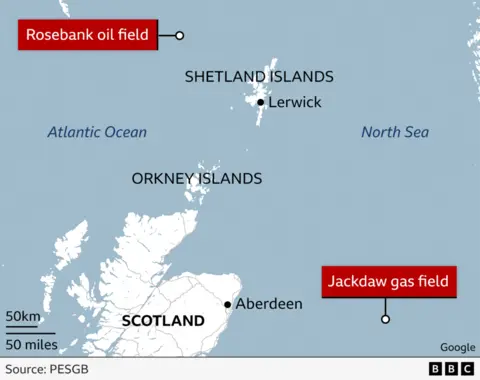
The decision over Rosebank is more difficult politically for the government than Jackdaw.
While most of Jackdaw's gas is likely to be consumed in the UK, Rosebank's oil will be taken off by tanker and sold on international markets.
Fahnbulleh acknowledged this in an interview with the BBC on Wednesday, saying Rosebank was a "different proposition" to Jackdaw as the oil will be exported.
Licences for both fields were granted by the then Conservative UK government in 2022 and 2023 - sparking legal challenges from environmental groups.
The Court of Session in Edinburgh ruled last year that Rosebank and Jackdaw had been unlawfully approved because the government had failed to take into account the climate impact of burning extracted oil and gas from the sites.
It was then for the UK government to decide whether to re-approve the fields, with input from industry regulators.
Labour has previously said it is opposed to the issuing of new exploration licences but it will consider new production projects if they are tied back to existing facilities.

Sign up for our Politics Essential newsletter to keep up with the inner workings of Westminster and beyond.
