Too much of Sturgeon's care 'Promise' remains on paper, report says

 PA Media
A report has found a flagship SNP policy - championed by Nicola Sturgeon - is running out of time to improve the care system.
The Scottish government signed up to The Promise in 2020 to make the lives of care-experienced children and young people better by 2030.
An update on its progress reveals too much of the pledge made to Scotland's children, families and care-experienced adults remains on paper, not in people's lives.
The independent oversight board for the Promise wants those with power to "move faster, with greater urgency and a determined focus".
The Scottish government said it had invested in whole family support, with plans for a new strategy before the deadline.
The report said progress had been made in a number of areas.
The passage of the Children (Care, Care Experience and Service Planning) (Scotland) Act 2026 was described as an "important development", creating new rights and responsibilities.
Effective partnerships, longer-term funding and flexible workers were highlighted as positives.
However, the document said good practice was uneven with reports of stretched teams, limited capacity and resources that did not match need.
The oversight board also concluded the process of creating new legislation "exposed serious concerns about affordability, capacity and deliverability."
Ministers have been urged to prioritise more effective use of data and further investment in the sector.
 Getty Images
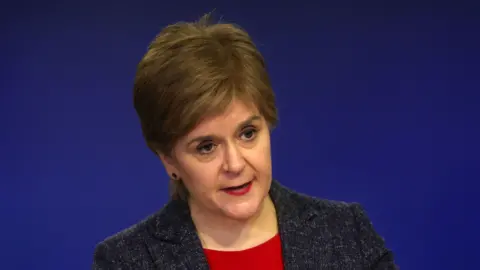
The Promise was launched during Nicola Sturgeon's time as first minister to improve the lives of care-experienced children and young people.
It accepted the 2020 Independent Care Review, which found the system was "fractured, bureaucratic and unfeeling."
In 2022, Sturgeon unveiled an 80-step plan which included ending custody for under-18s and creating a national allowance for foster and kinship carers.
The reforms also pledged to redesign children's hearings and overhaul governance by 2030.
Last year's report said that plans lacked detail and direction for individual sectors, and new structures created by the Scottish government had lacked clarity about their roles and responsibilities.
Reports prior to this were also critical.
In 2024, the former first minister admitted the programme was not meeting its aims.
Sturgeon said the plan had suffered from "an implementation gap between the aspirations of the policy and the impact on children in care".
She said it would be "unthinkable" for the Promise not to be delivered.
'Activity is not the same as action'

David Anderson, chairman of the oversight board, said: "We have seen that progress has been made, people are working hard and they care.
"Great care is being delivered every day but there's not enough progress in some areas.
"But the Promise ultimately has to be judged by whether those changes improve people's lives. Activity is not the same as action and Scotland must show whether support is reaching people, whether barriers are reducing and whether experience is changing."
Siobhian Brown, minister for the Promise, said the report recognised that real progress was happening across Scotland.
She said: "Crucially, it acknowledges that we can keep the Promise by 2030 if we increase the scale of interventions and pace of efforts across the country.
"The Scottish government has passed landmark legislation to accelerate delivery of the Promise, made significant investment in whole family support, strengthened support for foster and kinship carers, established the National Social Work Agency and ended the placement of under-18s in young offender institutions.
"However, we know progress is not yet experienced consistently by every child and family, and are taking action to address this."
She said the government was working towards each of the report's recommendations.