Uncertain future for ageing Cambridge Guildhall

 Dave Webster/BBC
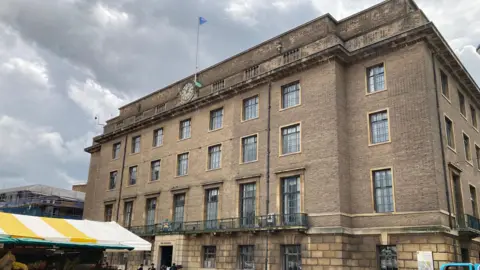
A 1930s building on a city centre site that has been the heart of civic life for 800 years is at risk of falling apart, according to a report.
Cambridge City Council said the Guildhall on Market Square could succumb to "Regent Street Disease" - a defect affecting early 20th Century steel-framed buildings.
Councillors will debate different options to save the Guildhall at a meeting on Tuesday, including paying for repairs or selling it to become a boutique hotel.
The report said the Guildhall was facing "significant challenges".
This included a risk of falling masonry from its external facade and water in the roof space above the chamber.
The Grade II-listed Guildhall, which was built in 1939, sits on a site that has long been associated with civic life in Cambridge.
Standing opposite the market, it has been used through the ages as a prison, toll booth, and more recently the seat of local government for Cambridge City Council.
It was remodelled from the old Guildhall, which was built in the 18th Century, and in turn replaced a medieval building known as the Guildhall or "gyldehalle".
Much of the current Guildhall has stood empty since 2020, with the council chamber and event spaces remaining in regular use.
It was closed to the public in October, and the last event in its large and small halls takes place on 20 December.
 Capturing Cambridge/Museum of Cambridge
The council is planning a £96m regeneration of the Civic Quarter, an area in central Cambridge made up of the Guildhall, Corn Exchange and Market Square.
A council report said the deteriorating Guildhall faced "significant challenges" after being given only "basic maintenance and minor upgrades" in the last 30 years.
Problems include leaky pipes, a risk of masonry falling from the facade, and ceiling finishes where there is a "significant risk" they could "fall apart".
 Capturing Cambridge/Museum of Cambridge
The building is also thought to be at risk of "Regent Street Disease", named after the area in London's West End, where the steel frame of buildings of the same age and construction style are prone to corrosion.
A scrutiny committee is being asked to consider different options for the building's future, including a full refurbishment, followed by using the building or renting it out.
Another option is to "kick the can" by putting off the Guildhall refurbishments, with a fourth option to sell the site – "most likely to become a boutique hotel".
In this case, "800 years of civic use on the site would end", according to the report.
 Capturing Cambridge/Museum of Cambridge
Roger Lilley, chairman of trustees at the Museum of Cambridge, said the situation was "very disappointing" for the city.
"This is the last remnant of civic government in Cambridge, where it's been for hundreds of years," he said.
"To lose that location where, with more foresight and planning, something could've been created which would've been an enormous benefit, it's very disappointing."
In March, plans to refurbish the Guildhall were approved, including creating an accessible council chamber, new meeting rooms, new electrical infrastructure and conservation works.
No final decision will be made on Tuesday, with councillors instead being asked for their views on the different options.
Do you have a story suggestion for Cambridgeshire? Contact us below.
Follow Cambridgeshire news on BBC Sounds, Facebook, Instagram and X.