Sizewell C terrible deal for taxpayers, say MPs

 Sizewell C
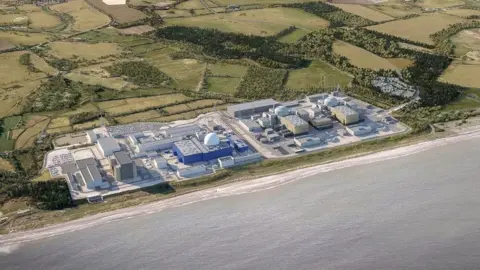
A new nuclear power station on the Suffolk coast has been branded a "terrible deal" for taxpayers by a committee of MPs.
A report published by the House of Commons' Public Accounts Committee (PAC) said Sizewell C, near Leiston, was "high risk" and it would be the taxpayer who would foot the majority of the bill if there were delays.
The project is expected to cost between £40.5bn and £47.7bn, with construction finishing between 2039 and 2043.
In response, Nigel Cann, chief executive of Sizewell C, said the power station would "strengthen the country's energy independence".
PAC, which examines the value for money of government projects, said it was "deeply concerned" that if costs exceeded projections, private investors would only have to provide an additional £30m compared to an additional £9.8bn paid by consumers during construction, and £12bn over the 60-year operating contract through higher energy bills.
It said it was crucial the project was delivered on time to set the "government on much stronger footing for future deals, and ensure the financial risks of any future schemes can be distributed more fairly".
But it warned the design of the station had previously been used on other projects, including for Hinkley Point C in Somerset, and there was a "clear pattern of significant delays and substantial cost escalations".
"No comparable nuclear power station anywhere in the world has been built on time and to budget," the committee added.
 Ross Pollard/BBC
Conservative MP Sir Geoffrey Clifton-Brown, chair of PAC, said the "high level of risk borne by taxpayers and consumers" was "extraordinary".
"Private investors look set for significant returns on their investments, while customers are likely to be saddled with higher energy bills," he said.
"The government must focus on the successful delivery of this project, not just of a new nuclear power station, but of a commercially de-risked nuclear sector for a taxpayer that should never be put in this position again."
 Martin Giles/BBC
Cann, in response to the committee's report, said Sizewell C was the "right investment for Britain" and it would lower bills and provide "reliable low-carbon electricity for generations".
"Recent energy price shocks have exposed the risks of being overly reliant on imported fossil fuels," he explained.
"That is exactly why Britain needs new nuclear. By generating power here at home, Sizewell C will help protect households and businesses from the volatility of global energy markets."
Cann added that the project was "building on a proven design, a skilled workforce and an experienced supply chain, drawing on years of practical experience to improve productivity and reduce risk".
He also highlighted that thousands of jobs were supported by both the construction and eventual running of the nuclear station, and there were "more than 1,000 suppliers" working on the project.
A Department for Energy Security and Net Zero spokesperson said, in response to the report, that it "completely ignores that investors are incentivised to complete construction as cheaply and quickly as possible".
"We need to build new nuclear to move the country off expensive fossil fuels and on to clean, homegrown energy we control," they added.
"Once operational, Sizewell C could save £2bn a year across the energy system, cutting costs for families up and down the country, and the project is already making good progress with over 2,000 workers on site."
 Martin Giles/BBC
Alison Downes from campaign group Stop Sizewell C, and Prof Steve Thomas of Greenwich Business School, said in a joint statement they wanted the government to cancel Sizewell C "before any more public money is wasted".
"With the nation reeling under a cost of living crisis, consumers must be protected now and in the future from the risks of building nuclear power stations," they said.
"We call on the chancellor in his Budget to make a commitment that the RAB (Regulated Asset Base) funding model will never be used again for any future nuclear project.
"All it offers is a free ride for investors and financial pain for households."
The RAB model has already been used to finance other large infrastructure projects like the Thames Tideway "super sewer", and it allows investors to receive returns before the projects have been completed.
Another parliamentary committee of MPs in 2023 expressed concerns over the model and questioned whether it represented value for money, noting that the "taxpayer is taking an unknown and uncertain risk of cost overruns".
However, the government previously said the model could reduce project costs by more than £30bn.
Tom Greatrex, chief executive of the Nuclear Industry Association, said Sizewell C would "deliver electricity system savings of £2bn a year" with a finance model that "costs consumers less by attracting new private investment".
"Currently, the consumer is footing a bill of £2.8bn so far this year to manage a dysfunctional grid, paying both for wind to stop generating at some times, and for gas-powered back-up at others," he said.
"The only way to stop that escalation is with more baseload power, and international experience demonstrates the most cost-effective way to do that is by repeat building the same design. This is precisely what the UK is doing."
Do you have a story suggestion for Suffolk? Contact us below.
Follow Suffolk news on BBC Sounds, Facebook, Instagram and X.